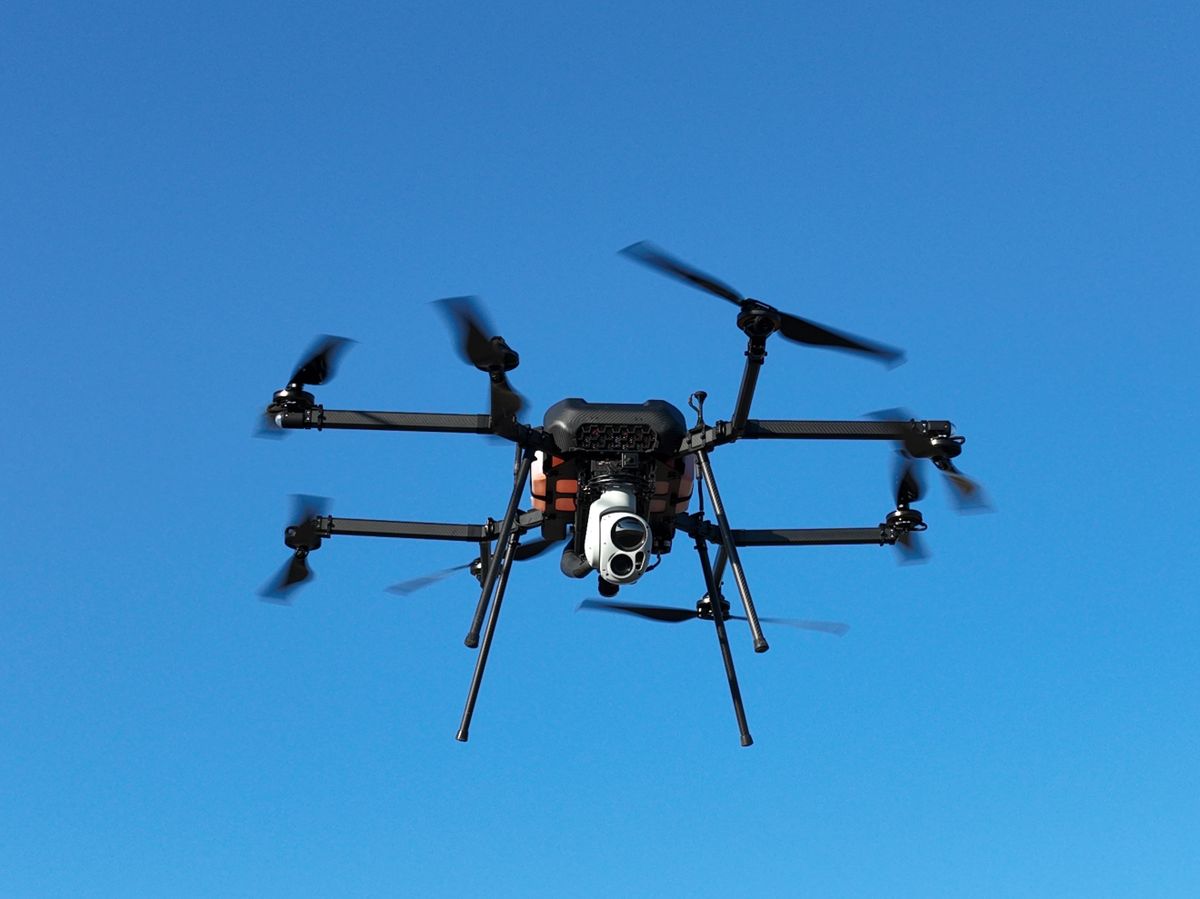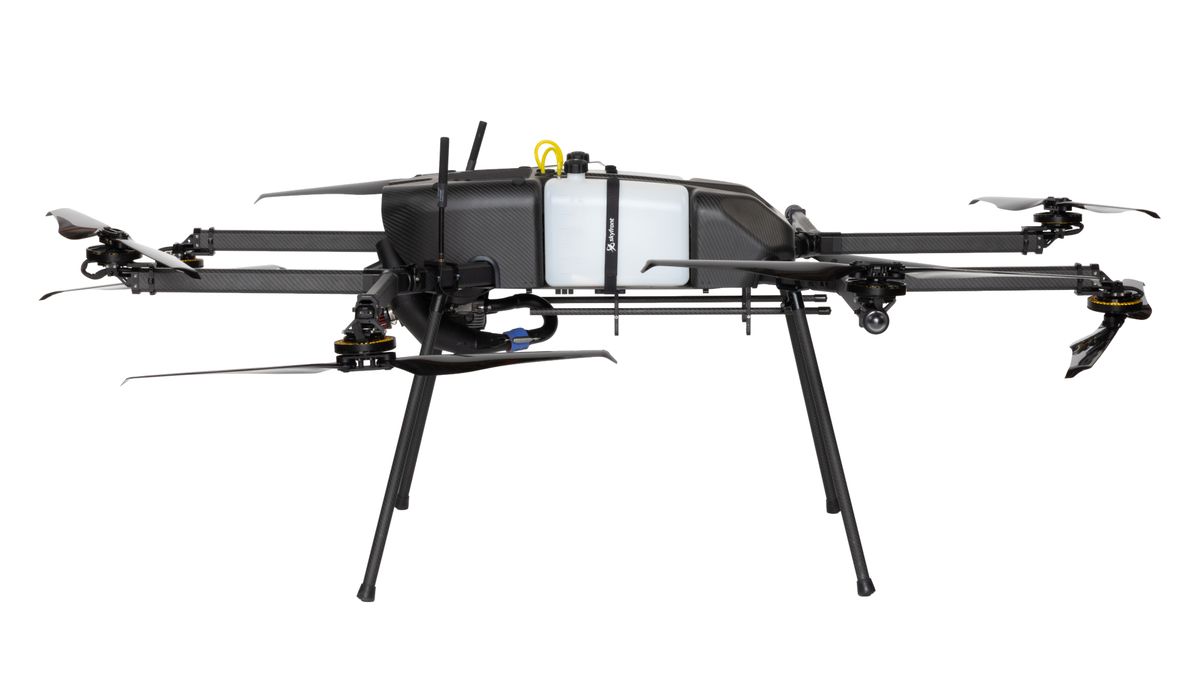
Battery powered drones have a hard ceiling. A lithium ion cell stores roughly 300 Wh per kilogram, and most of that weight has to be carried aloft by the drone's own propulsion. The result is a multirotor flight time of 45 minutes. To fly for hours instead of minutes, the energy source has to change.
That is what a hybrid drone does. It replaces the battery as the primary energy reservoir with liquid fuel, then uses an onboard generator to produce electricity on demand. The motors and propellers remain electric. Endurance becomes a function of fuel tank size rather than battery chemistry.
What is a hybrid drone?
A hybrid drone, also called a hybrid electric drone or hybrid UAV, is an unmanned aircraft that combines a small internal combustion engine with electric motors. The engine does not turn the propellers directly. Instead, it drives a generator that produces electricity, which powers the motors through a power management system. A small battery stays in the loop as a buffer, handling transient power demands and providing redundancy if the engine stops.
This is called a series hybrid architecture. It is the design used in the Skyfront Perimeter 8 and in essentially every long endurance multirotor in service today.
Hybrid drone components
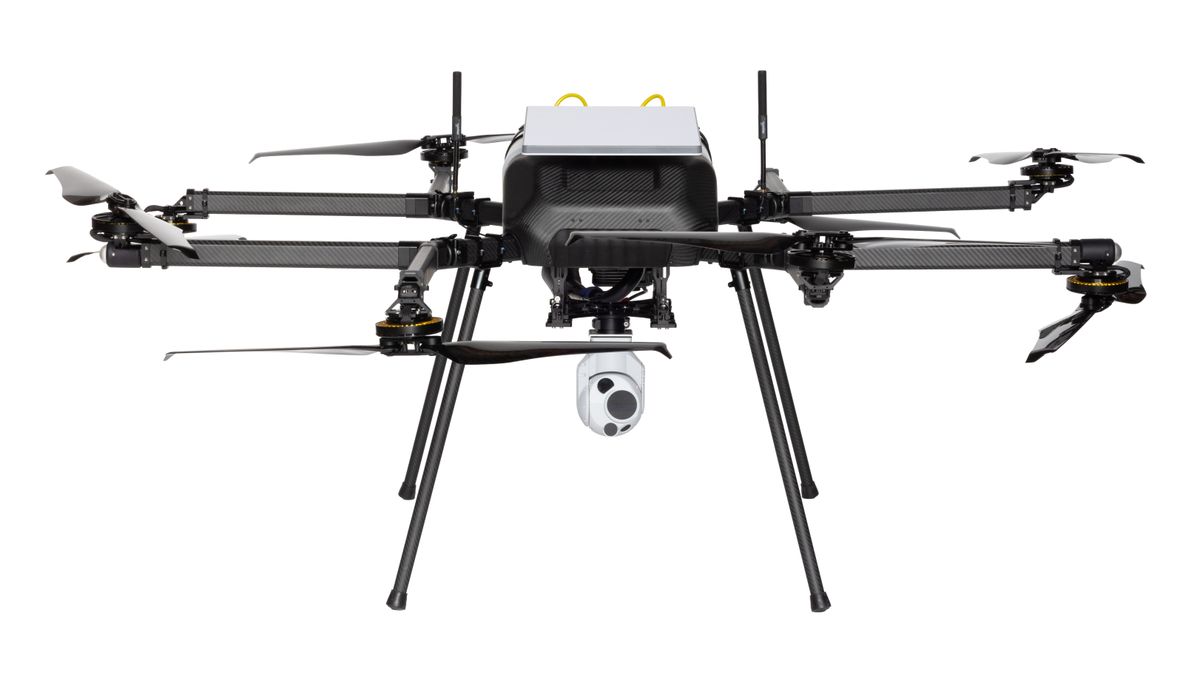
Energy flows from the fuel tank to the propellers through five stages:
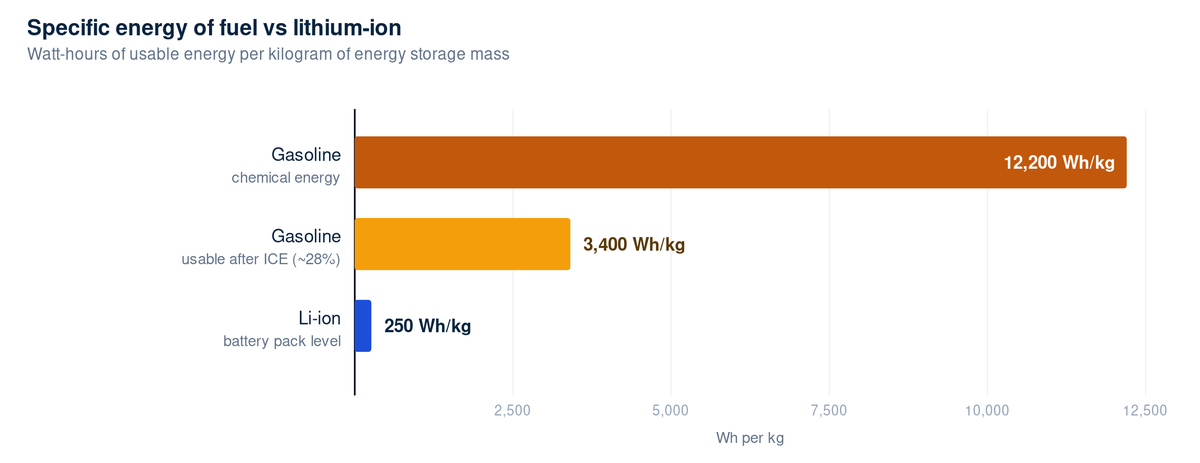
1. Fuel tank. Holds gasoline / benzine / petrol. Gasoline carries roughly 12,200 Wh per kilogram of chemical energy, about 50 times more than a lithium ion cell of equal weight.
2. Internal combustion engine. A small, lightweight engine converts fuel into rotational mechanical energy. Modern drone engines are typically two-stroke designs, optimized for power-to-weight rather than automotive efficiency.
3. Generator. Coupled directly to the engine's output shaft, the generator converts rotation into electrical current. A brushless permanent magnet generator is the standard choice for its efficiency and low maintenance.
4. Power management and buffer battery. A rectifier converts the generator's AC output to DC. A small lithium ion battery sits on the bus to absorb transients, smooth power delivery, and act as a backup. If the engine stops mid-flight, the battery alone has enough capacity to land the aircraft safely.
5. ESCs and motors. From the DC bus, electronic speed controllers drive the brushless motors that turn the propellers. Each motor is independently controlled, exactly as in a conventional electric multirotor.
The pilot experience is identical to flying a battery drone. The control loops, autopilot, and flight characteristics are unchanged. Only the energy source is different.
Series hybrid vs parallel hybrid architectures
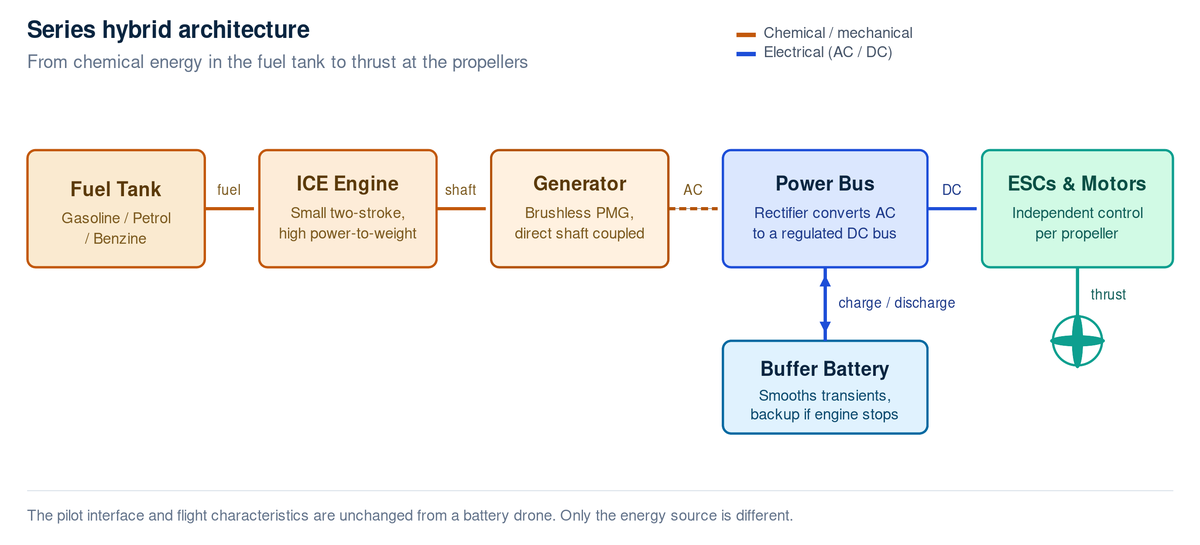
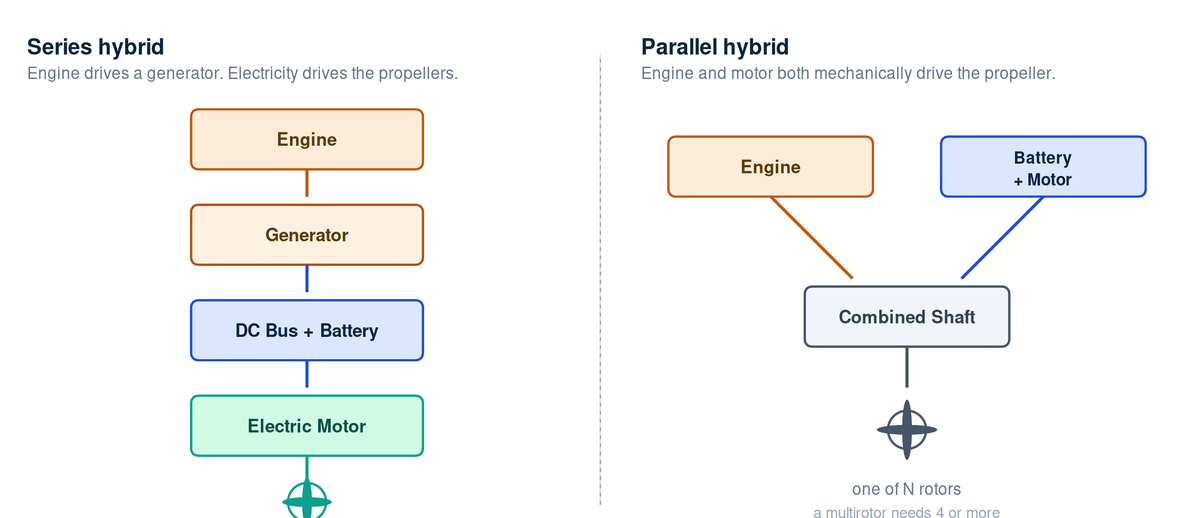
There are two ways to combine an engine and an electric motor. In a parallel hybrid, both the engine and the electric motor can mechanically drive the rotor. This is how the Toyota Prius works on the ground. In a series hybrid, the engine never touches the propeller. It only generates electricity.
For a multirotor, the series architecture is preferred. A quadcopter has four rotors. An octocopter has eight. Because each rotor needs to vary its thrust independently to keep the aircraft stable, a parallel architecture would require a separate engine mechanically coupled to every rotor. That means at least four engines on a quadcopter, eight on an octocopter, instead of one. Every additional engine multiplies fuel system complexity, weight, maintenance burden, cost, and single points of failure. The series architecture solves the problem with one engine and one generator, then lets every rotor stay fully electronically controlled while drawing from the same fuel source.
The energy density of fuel
The reason hybrid drones fly longer is straightforward chemistry. A kilogram of gasoline holds about 12,200 Wh of chemical energy. A kilogram of a high quality lithium ion battery pack holds about 250 Wh. Even after accounting for the inefficiency of a small internal combustion engine, gasoline delivers roughly 14 times more usable energy per kilogram than batteries.
That difference compounds. A drone designed around fuel needs only a small generator and a small buffer battery rather than dragging a heavy pack into the air. The mass it would have spent on batteries becomes fuel, payload, or both. This is the structural advantage that battery drones cannot close, regardless of cell chemistry improvements.
Hybrid drone flight times
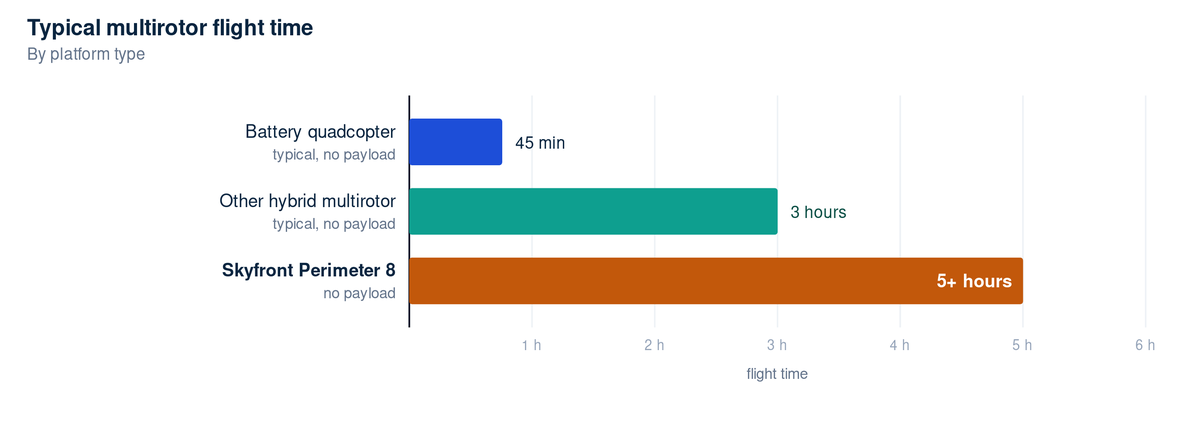
Typical battery multirotors fly 25 to 45 minutes with no payload, and 15 to 25 minutes with a meaningful sensor or camera. A hybrid multirotor of similar size flies 4 to 13 hours depending on payload and fuel load. The Skyfront Perimeter 8 holds the world record for multirotor endurance at 13 hours, achieved in March 2021.
That difference changes what a drone is useful for. Thirty minutes is enough for a single inspection target or a small mapping run. Five or more hours is enough to cover a national park boundary, monitor a pipeline corridor end to end, or hold a surveillance station over an objective without rotating aircraft.
Hybrid drones get lighter as they fly
A hybrid drone is heaviest at takeoff and lightest at landing. Every minute of flight consumes gasoline, and that fuel mass leaves the aircraft as exhaust. A multirotor that begins a mission with a full fuel tank can finish hours later at roughly 25 to 30 percent lower mass than it started.
This compounds endurance beyond the raw energy advantage of fuel. Less aircraft mass means less thrust required to hover. Less thrust means less current drawn from the motors, less load on the generator, and a lower engine load. The whole propulsion chain becomes more efficient as the flight continues, and component wear drops with it because motors, ESCs, and the engine all spend most of the flight operating below their initial load point.
Battery powered drones get none of this. A lithium ion cell weighs the same at 0% state of charge as it does at 100%. The aircraft has identical mass on its final battery percentage as on its first. Every minute of hover demands the same current, right up to the moment the battery quits. The aircraft does not benefit from consuming its own energy storage because no mass is consumed.
Over a long mission, the compounded effect adds meaningfully to total endurance and lowers the per-hour operating load on every component in the propulsion system. A hybrid drone in the final hour of a five hour flight is operating at noticeably lower power than it was at takeoff. A battery drone in its final minute is working its motors as hard as in its first.
Hybrid Drones: Pros and Cons
Hybrid drones are not the right answer for every mission. They produce engine noise, which makes them less suitable for missions where acoustic signature matters. They emit a small thermal signature visible to infrared sensors, though far smaller than a manned helicopter.
For missions under 30 minutes where the drone returns to a charger between flights, battery electric is often the simpler choice. Hybrid drones earn their complexity when endurance, range, or remote operation become the deciding factors.
Applications for Hybrid Drones
Hybrid drones dominate any mission where a battery drone would have to land, swap, and relaunch. Specific applications include:
Long range ISR and surveillance. Holding an overwatch station for hours rather than minutes.
Search and rescue. Covering large search areas without recovery breaks that lose ground to a moving target.
Magnetometry and geophysical survey. Flying long parallel survey lines for mineral exploration or UXO detection without battery induced restarts that introduce data discontinuities. These missions are often in rugged remote areas where shipping and charging batteries are impossible.
LiDAR mapping. Capturing large area surveys in a single flight rather than stitching dozens of smaller flights.
Pipeline and powerline inspection. Following linear infrastructure that extends for tens or hundreds of kilometers in a single sortie.
Maritime and offshore operations. Where every recovery and relaunch cycle is expensive and risky.
Cold weather operations. Where lithium ion batteries lose capacity sharply and gasoline engines remain functional.
The Skyfront Perimeter 8
The Perimeter 8 is Skyfront's production hybrid drone and the platform behind the world endurance record. The P8 has a 10 kilogram payload capacity, and 5 or more hours of endurance. It is fielded in more than 30 countries and is on the U.S. Department of Defense Blue UAS Select list, which means it is approved for U.S. government use under NDAA Section 848.
It has been demonstrated in cold weather operations at minus 16 Celsius near Fort Greely, Alaska, in 30 to 40 mile per hour winds. It carries Silvus MANET radios for resilient mesh communications and supports LiDAR, EO/IR, magnetometer, and custom sensor payloads through a standardized integration interface.
If you have a mission that needs more than a battery drone can deliver, the Perimeter 8 is the platform built for it.