In brief
For most of unmanned aviation's history, the limiting subsystem was never the airframe, the engine, or the sensor. It was the radio. Starlink has removed that constraint for all practical purposes: a broadband, low-latency satellite link that once demanded a Predator-sized aircraft, a steerable dish, and a defense ministry's budget, now weighs about a kilogram, draws the power of a laptop, and bills like a household utility.
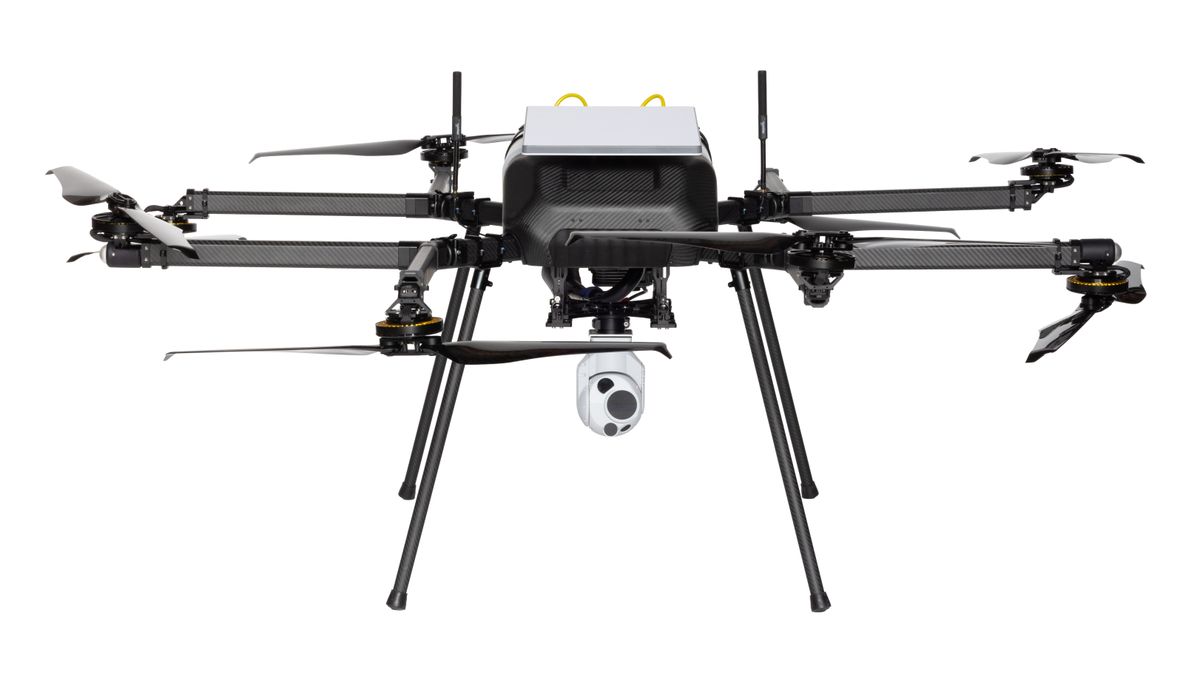
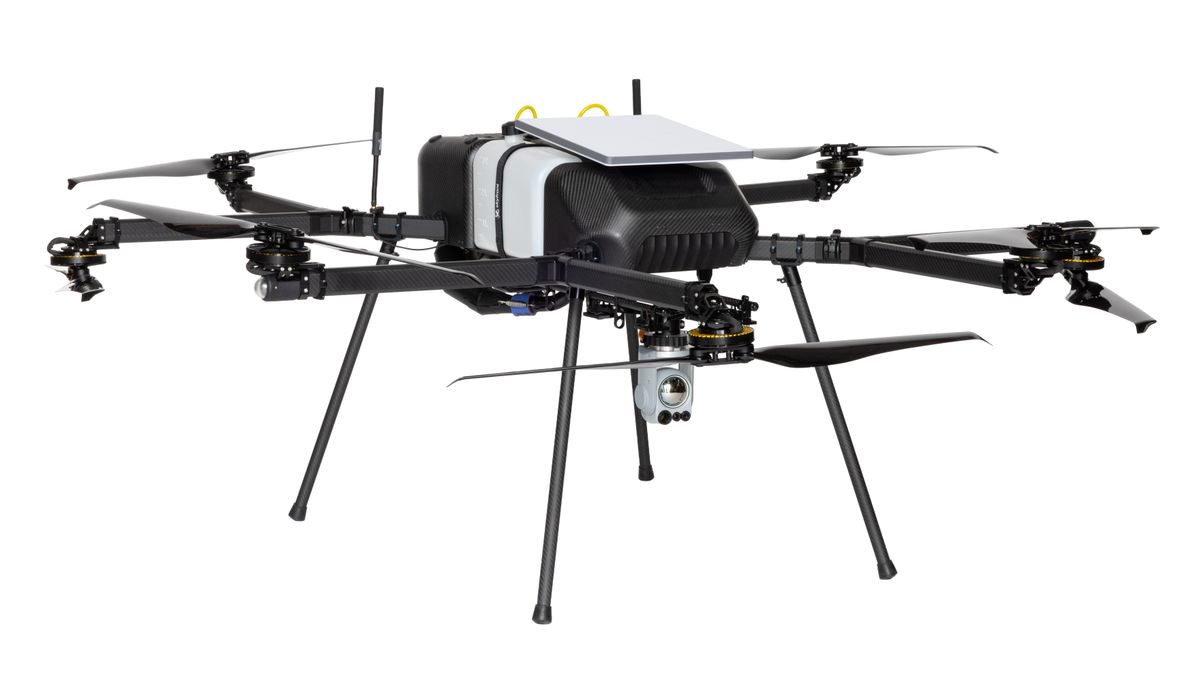
But a link with no horizon is only as useful as the aircraft asked to carry it. While much of the industry waited on connectivity, Skyfront decisively solved endurance: the Perimeter 8, an affordable hybrid gas-electric multirotor, holds its class's flight-time world record at 13 hours.
Where a battery quadcopter struggles to haul a 25-to-40-watt terminal weighing over a kilogram, an aircraft that generates its own electricity in flight carries broadband satcom, alongside a full sensor payload, for hours. And because Skyfront flies Starlink as one layer of a multilink stack, cellular and encrypted tactical mesh radios with automatic failover, never a sole umbilical, the documented strategic risk of depending on a single provider need not be compromising. The U.S. Army put the architecture to the test in 2026, flying the Perimeter 8 on night BVLOS overwatch from inside moving armored vehicles while the aircraft climbed to relay the network to the units below.
The over-the-horizon reach that once belonged to only a dozen militaries now stretches from the Black Sea to rural America, and the aircraft built to exploit it are already in the field, successfully deployed in 30+ countries.
How did drones communicate before Starlink?
Every drone lives within three budgets: endurance, payload, and link. The first two yield to engineering, and in these cases Skyfront leads. The third, until recently, yielded mainly to money, and not always then.
The standard instrument was the line-of-sight radio. Digital datalinks between 900 MHz and 5.8 GHz carry control and video dependably, but no farther than terrain, foliage, and the curvature of the earth permit. Operators bought back range with repeaters, masts, and chase vehicles, each of which added cost, logistics, and other potential points of failure.
Cellular came next. LTE and 5G turned out to be serviceable drone links in cities and suburbs, and a generation of drone-in-a-box products was built on them. But a coverage map is a census map, not a map of where important drone missions need performing. And in a disaster, when the aircraft are most wanted, the terrestrial network is often the first casualty. During Hurricane Ian in 2022, parts of Florida lost cellular service outright at the hour first responders needed it most.
Satellite communication existed, in two unsatisfying forms. Geostationary satellites orbit at some 36,000 kilometers, a distance that imposes roughly 600 milliseconds of round-trip delay, disqualifying to all but a small subset of missions. The terminals were heavy, mechanically steered, power-hungry, and priced for ministries of defense, which meant broadband over GEO was effectively reserved for aircraft the size of a small plane, flown by institutions with nine-figure budgets. Lighter low-orbit services such as Iridium offered genuinely global coverage at narrowband rates, but with throughput hopeless for live high-definition video.
The remaining option was to fly out of contact altogether, on pre-programmed missions with the data recovered at landing. Some survey work is still done this way. But an unconnected aircraft cannot be retasked, cannot stream, and cannot be supervised, and supervision is what regulators require before they will license routine flight beyond an observer's eyesight.
What does Starlink change for unmanned aircraft?
Starlink changed four things: altitude, scale, form factor, and cost. Skyfront is the only manufacturer of affordable drones uniquely positioned to fully leverage this change and proliferate its benefits.
Altitude first. Starlink's satellites orbit near 550 kilometers, one-sixtieth the distance of a geostationary platform, and at that range the speed of light stops being an adversary. Operators measure latency between 25 and 60 milliseconds, comparable to fiber broadband. That is fast enough to fly an aircraft, camera and all, from the far side of the planet.
Scale second. Starlink’s satellites are numerous enough to offer unusual resilience to weather, congestion, and deliberate interference. SpaceX's president has observed that a constellation so numerous is a difficult thing to aim a weapon at.
On form factor: the Starlink Mini, introduced in 2024, is a flat, electronically steered terminal of about 1.1 kilograms, drawing 25 to 40 watts, sealed to IP67, delivering downloads above 100 Mbps. There is no dish to point and no gimbal to stabilize; the beam is steered in silicon. For the first time, a powerful long endurance mid-sized multirotor can carry true broadband satcom as ordinary cargo together with camera, lidar, magnetometer, or other sensor. Skyfront is the only mature and tested manufacturer of reliable, accessible drones on the market optimized for such a payload still able to fly missions of meaningful length.
Last, price. Aviation satcom has often meant initial capital costs in the hundreds of thousands of dollars for the, with continuing airtime billed to match. Starlink hardware sells for a few hundred dollars and service for tens to a few hundred per month. Together with Skyfront’s affordable, heavy lift, high endurance drones, the addressable market has increased thousands fold.
Ukraine: the proving ground
Ukraine proved Starlink’s transformative effect in a way no testing ground could. Terminals reached the country within days of the invasion, after missile strikes and cyberattack crippled terrestrial networks; before that, Kyiv had depended on slower and costlier services, Inmarsat and Thuraya among them. By 2024 the government counted some 42,000 terminals across the military, hospitals, businesses, and relief organizations, with Poland underwriting $50 million a year. Valerii Zaluzhnyi, the former commander-in-chief, has argued publicly that the war rewrote military doctrine: that drones, not expensive precision munitions, became the decisive instrument.
The maritime case is striking: In September 2022, a small uncrewed boat washed ashore near Sevastopol with a Starlink terminal bolted to its stern. On October 29, a coordinated group of explosive-laden naval drones, guided over satellite by operators far from the water, struck the Russian Black Sea Fleet in its home anchorage. What followed is now naval history. By February 2024, Britain's Chief of the Defence Staff assessed that Ukraine, a country with no fleet worth the name, had sunk or disabled a quarter of Russia's Black Sea Fleet; the following month, London described that fleet as functionally inactive, its principal combatants withdrawn. Ukrainian technical advisers later confirmed: a new class of weapon, the long-range uncrewed surface vessel, was built on a consumer internet product.
Ubiquitous low-latency satellite broadband has become the preferred link for unmanned systems.
What Starlink enabled
Linear infrastructure is the plainest commercial beneficiary. Pipelines, transmission corridors, railways, and aqueducts run for hundreds of miles through exactly the terrain that defeats both RF and cellular. With a satellite-linked aircraft, an inspection program no longer plans around communications geography; the link is present from the first mile to the last. The same logic extends offshore, to wind farms, platforms, and search and rescue, where the alternative had been crewed helicopters at several thousand dollars per flight hour, or nothing at all.
A subtler consequence concerns the data. When an aircraft can push live video to the cloud from anywhere, analysis no longer waits for landing. Starlink can feed the video stream straight into cloud analytics for live analysis, connecting field assets to engineers in a distant office.
Some applications were not just expensive before low-orbit broadband. They were impossible.
When the control link rides the internet, the pilot's location becomes a preference. A mission launched on one continent can be supervised, or flown, from an operations center on another, with command handoff between ground stations in flight. For an organization, this turns pilots from a cost incurred at every site into a centralized resource.
Public-safety programs show the change at municipal scale. Drone-as-first-responder systems had been confined by LTE coverage and short radio tethers to a radius of about three miles per launch site. Pair the satellite link with a long-endurance airframe and the geometry changes. A Skyfront Perimeter 8 flying on Starlink can reach incidents tens of miles out and remain overhead for hours, its radius set by the fuel tank rather than the network, and it keeps working where towers are absent or saturated: offshore incidents, wildfires, the congested aftermath of a major event. One launch site begins to do the work of many.
A satellite-linked drone in a disaster is also infrastructure in its own right. A long-endurance aircraft carrying radios and a satellite backhaul can hold station as a temporary cell site or mesh node above a flood zone or a forward unit, bridging teams that terrain or catastrophe has separated. The Skyfront Perimeter 8 has flown in that precise role for the U.S. Army, as much an airborne network as an airborne camera.
The single-provider problem
In September 2022, by the account in Walter Isaacson's Musk biography and later reporting, Ukrainian drone boats closing on the Russian fleet near Crimea lost their link when Musk declined to extend coverage, judging the strike escalatory; the attack failed and the boats washed ashore. The following February, SpaceX president Gwynne Shotwell confirmed the company had moved to curb Ukraine's use of the network for strikes, saying "it was never intended to be weaponized." In February 2025, Reuters reported that Washington had floated cutting Ukraine's access as leverage in minerals talks, which Musk denied; weeks later, quarreling with Poland's foreign minister, he wrote that Ukraine's "entire front line would collapse if I turned it off," even as he pledged never to switch the terminals off. The pledge was welcome. But the world heard that one individual could credibly make the threat.
Skyfront is uniquely prepared to offer its customers protection against Starlink as a potential single point of failure. As a mature manufacturer of ultra long endurance multicopters, Skyfront wrestled with, invented, and perfected many communications solutions appropriate to BVLOS long before the emergence of Starlink. The practical hedge at the aircraft level often includes multilink architecture: satellite, cellular, and tactical mesh radios, with automatic failover, so that the loss, throttling, or geofencing of any one network never ends a mission. Skyfront drones are also able to hover long enough to provide their own communications relay network to other assets, including mothership deployed FPV drones.
How Skyfront uses Starlink
The Perimeter 8 hybrid gas-electric multirotor solved endurance first; it holds the flight-time world record for its class at 13 hours. With Starlink, the longest range hybrid electric multirotor has an inexpensive data link with no horizon.
Two engineering facts make the pairing natural. The first is power. A Starlink terminal's draw of 25 to 40 watts and a weight of over a kilogram is a burden on a battery quadcopter; it is hardly noticeable for an aircraft that generates electricity from gasoline as it flies. Hybrid propulsion extends flight time far beyond other options, and it makes broadband satcom effectively free to carry. The second is design philosophy. Skyfront ships Starlink as one layer of a multilink stack, alongside LTE and tactical mesh datalinks from Silvus Technologies, Persistent Systems, Doodle Labs, and RFD, with AES-256 encryption, rather than as a sole umbilical. Neither the aircraft nor the customer is hostage to any one network.
Skyfront has developed a way to encrypt the link between the ground and drone Starlink terminals, allowing the ground station to communicate securely with any device connected to the drone's Starlink, and vice versa. By default, this link is protected with strong AES-256 encryption. This protection isn't included with Starlink out of the box; it has to be added. And if you're controlling a UAS or viewing its video feed, it's essential.
The architecture was tested under military conditions in 2026, when Skyfront and its partner AeroIntel Systems fielded the Perimeter 8 with U.S. Army soldiers in Colorado under a federal contract. The aircraft flew night BVLOS surveillance controlled from inside moving armored vehicles, with Silvus MANET radios and Persistent Systems Wave Relay carrying the tactical mesh and Starlink providing over-the-horizon backhaul into the Army's command network. Thermal imagery moved from the gimbal, through the vehicle, to the wider force without interruption, and where terrain demanded it, the Perimeter 8 climbed to serve as an airborne relay, carrying multiple radios aloft to join dispersed units. By the end of the deployment, soldiers rather than engineers were flying ten-mile overwatch.
The same stack serves civilian programs. Command-and-control handoff lets any authorized ground station, across the site or across an ocean, take the aircraft and its video in mid-mission, which is the foundation of centralized, multi-site drone operations.
Starlink options on the Perimeter 8 today
Skyfront offers Starlink as a factory-integrated option across the Perimeter 8 family (Perimeter 8 and Perimeter 8+), configured to the mission:
Satellite command, control, and HD video over the horizon, so that operating radius is set by fuel and airspace authorization rather than by RF physics; extended video-and-control configurations pair with the satellite link.
Starlink alongside LTE and tactical mesh radios (Silvus, Persistent Systems Wave Relay, Doodle Labs, RFD), engineered for layered redundancy and automatic use of the best available path, with AES-256 encrypted datalinks.
Relay and backhaul configurations, in which the P8 carries Starlink as an airborne network backhaul extending connectivity to teams below.
Continuous hybrid power to the terminal, so that connectivity does not trade against flight time as it does on battery aircraft.
Contact Skyfront to configure a Perimeter 8 with satellite connectivity for your application.
FAQ
Can you control a drone over Starlink?
Yes. Latency on the low-orbit network runs 25 to 60 milliseconds, fast enough for real-time command, control, and live HD video. Drones have been flown and navigated over Starlink in real time in commercial demonstrations, and both belligerents in Ukraine now operate satellite-linked drones at scale.
What did drones use for long-range communication before Starlink?
Line-of-sight radios, limited by horizon and terrain; cellular LTE, limited to tower coverage; narrowband low-orbit services such as Iridium, global but kilobit-class; and geostationary satcom, which offered broadband at roughly 600 milliseconds of delay through terminals practical only for large military aircraft.
How much does Starlink for a drone cost compared with legacy satcom?
Starlink hardware costs a few hundred dollars, with service from tens to a few hundred dollars per month. Comparable beyond-line-of-sight broadband previously required terminals and airtime priced for defense budgets, commonly tens to hundreds of thousands of dollars. The difference is on the order of a hundredfold.
Is Starlink too heavy or power-hungry for drones?
Not anymore. The Starlink Mini weighs about 1.1 kg (2.4 lb) and draws 25 to 40 watts. That load is hard on small battery multirotors and is trivial for the hybrid gas-electric Skyfront Perimeter 8, which generates power onboard and carries up to 10 kg of payload for an hour, or 5 kg for three hours.
What happens if the satellite link drops mid-mission?
On a properly designed aircraft, nothing dramatic. Skyfront's multilink architecture runs Starlink alongside LTE and encrypted tactical mesh radios with failover among them, and the autopilot executes configurable lost-link behavior (continue mission, loiter, or return) if all links degrade. Redundant command and control is also a central expectation of the FAA's proposed Part 108 BVLOS rule.
Does relying on Starlink create strategic risk?
It can. Access has been restricted, geofenced, and publicly threatened during the war in Ukraine, which is why governments are funding alternatives (Europe's IRIS², Taiwan's sovereign program, China's Guowang and Qianfan). This is why serious operators specify multi-network aircraft like Skyfront’s.


